
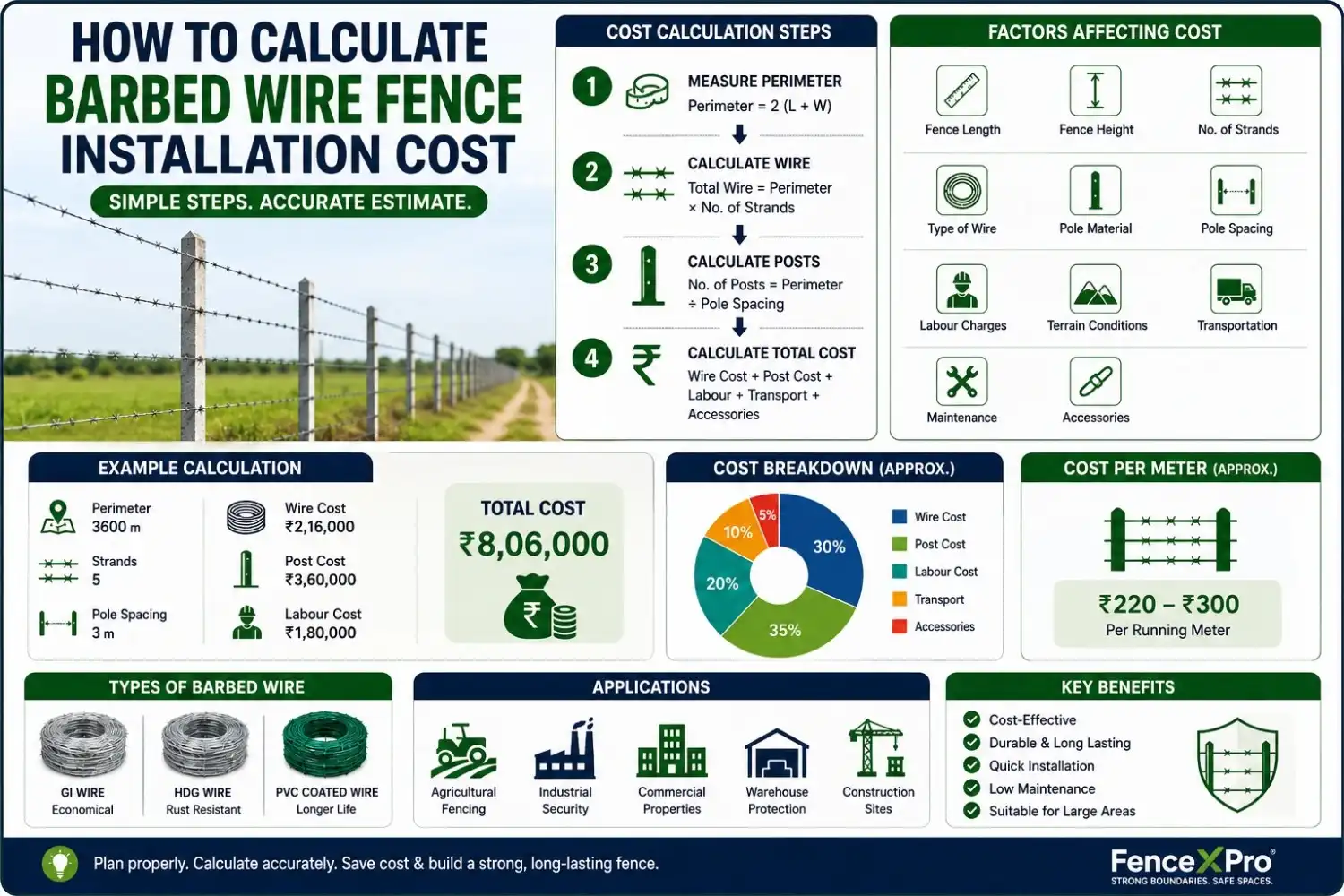
Installing a barbed wire fence may seem straightforward, but accurately estimating the total project cost is often more challenging than most property owners expect.
Many people calculate fencing expenses based only on the price of barbed wire rolls. However, a successful fencing project involves much more than wire alone. Fence posts, labour, transportation, corner supports, installation accessories, terrain conditions, and maintenance requirements all influence the final budget.
Whether you are fencing agricultural land, a factory boundary, a warehouse, a construction site, or a commercial plot, understanding the complete cost structure helps you make informed decisions and avoid unexpected expenses.
This guide explains how to calculate barbed wire fence installation costs step by step, along with practical examples, cost formulas, material estimates, and expert recommendations.
What Is Barbed Wire Fencing?
Barbed wire fencing is a boundary protection system made from steel wires fitted with sharp barbs at regular intervals. These barbs create a physical and psychological deterrent that helps prevent unauthorized access, livestock movement, and trespassing.
A standard barbed wire fencing system generally includes:
- Barbed wire strands
- Fence posts
- Corner posts
- Fasteners and clips
- Tensioning accessories
- Concrete foundations (where required)
Because of its affordability, durability, and ease of installation, barbed wire fencing remains widely used for agricultural fencing, industrial security, commercial boundaries, and perimeter protection projects.
Where Is Barbed Wire Fencing Commonly Used?
Agricultural Fencing
Farm owners use barbed wire fencing to:
- Protect crops
- Secure livestock
- Define property boundaries
- Prevent animal intrusion
Industrial Fencing
Industrial facilities use barbed wire fencing for:
- Factory perimeter security
- Equipment protection
- Restricted access zones
- Storage yard protection
Commercial Plot Protection
Barbed wire fencing helps:
- Secure vacant land
- Protect construction sites
- Mark property boundaries
- Prevent encroachments
Warehouse Security
Warehouses often combine chain link fencing with barbed wire for enhanced perimeter security.
Factors That Affect Barbed Wire Fence Installation Cost
Before calculating the total project cost, it is important to understand the factors that influence pricing.
1. Fence Length
The total perimeter of the property determines the quantity of wire, posts, and labour required.
| Fence Length | Cost Impact |
|---|---|
| 100 meters | Low |
| 500 meters | Moderate |
| 1000 meters | High |
| 5000+ meters | Very High |
Longer fences require more material and labour.
2. Fence Height
A taller fence requires:
- More wire strands
- Stronger support posts
- Additional labour
As fence height increases, material consumption also rises.
3. Number of Wire Strands
Different security requirements require different strand configurations.
| Security Requirement | Recommended Strands |
|---|---|
| Basic Boundary | 3–4 |
| Agricultural Security | 4–5 |
| Commercial Security | 5–6 |
| Industrial Security | 6–8 |
More strands increase both material and installation costs.
4. Type of Barbed Wire
Standard GI Barbed Wire
- Economical
- Suitable for general fencing
- Moderate lifespan
Hot-Dip Galvanized Wire
- Better corrosion resistance
- Longer lifespan
- Reduced maintenance
PVC Coated Barbed Wire
- Enhanced weather protection
- Improved durability
- Suitable for harsh environments
5. Pole Material
Common options include:
Concrete Poles
- Durable
- Strong
- Long service life
Steel Poles
- Fast installation
- High strength
- Popular for industrial projects
Angle Iron Posts
- Cost-effective
- Suitable for agricultural fencing
- Easy installation
6. Labour Charges
Labour costs vary depending on:
- Project size
- Soil conditions
- Fence height
- Site accessibility
- Local market rates
7. Terrain Conditions
Installation becomes more expensive when dealing with:
- Rocky soil
- Uneven terrain
- Waterlogged land
- Sloped areas
- Dense vegetation
Step-by-Step Formula to Calculate Barbed Wire Fencing Cost
Step 1: Calculate Property Perimeter
The perimeter determines the total fence length required.
Formula
Perimeter = 2 × (Length + Width)
Example
Property Length = 1000 meters
Property Width = 800 meters
Perimeter = 2 × (1000 + 800)
Perimeter = 3600 meters
This means you need fencing for 3600 running meters.
Step 2: Calculate Wire Requirement
Assume:
- Fence Length = 3600 meters
- Number of Strands = 5
Formula
Total Wire Required = Fence Length × Number of Strands
Total Wire Required = 3600 × 5
Total Wire Required = 18,000 meters
Step 3: Calculate Number of Fence Posts
Assume:
- Fence Length = 3600 meters
- Pole Spacing = 3 meters
Formula
Number of Posts = Fence Length ÷ Pole Spacing
Number of Posts = 3600 ÷ 3
Number of Posts = 1200 Posts
Always add extra corner and gate posts to the estimate.
Step 4: Calculate Wire Cost
Assume:
- Barbed Wire Price = ₹12 per meter
Formula
Wire Cost = Total Wire Required × Price Per Meter
Wire Cost = 18,000 × ₹12
Wire Cost = ₹2,16,000
Step 5: Calculate Pole Cost
Assume:
- Pole Price = ₹300 per pole
- Total Poles = 1200
Pole Cost = 1200 × ₹300
Pole Cost = ₹3,60,000
Step 6: Add Labour Cost
Assume labour cost:
₹50 per running meter
Labour Cost = 3600 × ₹50
Labour Cost = ₹1,80,000
Step 7: Add Transportation and Accessories
Estimated:
- Transportation = ₹30,000
- Fasteners & Accessories = ₹20,000
Step 8: Calculate Total Project Cost
| Component | Cost |
|---|---|
| Wire Cost | ₹2,16,000 |
| Pole Cost | ₹3,60,000 |
| Labour Cost | ₹1,80,000 |
| Transportation | ₹30,000 |
| Accessories | ₹20,000 |
| Total Cost | ₹8,06,000 |
How to Calculate Barbed Wire Cost Based on Area
In some projects, fencing calculations are performed using the fence area.
Formula
Area = Fence Length × Fence Height
Example:
Fence Length = 1000 meters
Fence Height = 3 meters
Area = 1000 × 3
Area = 3000 square meters
This method is particularly useful for large industrial and security fencing projects.
How to Calculate Required Rolls of Barbed Wire
Many buyers purchase fencing material by roll.
Formula
Number of Rolls = Total Wire Requirement ÷ Length Covered Per Roll
Example:
Total Wire Requirement = 3000 meters
Coverage Per Roll = 500 meters
Number of Rolls = 3000 ÷ 500
Number of Rolls = 6 Rolls
How to Calculate Barbed Wire Cost by Weight
Some suppliers sell wire by weight.
Formula
Total Cost = Total Weight × Price Per Kilogram
Example:
Weight Required = 240 kg
Price Per Kg = ₹65
Total Cost = 240 × ₹65
Total Cost = ₹15,600
This method helps compare supplier quotations more accurately.
Barbed Wire Fence Cost Per Acre
One acre equals approximately 43,560 square feet.
A square acre typically requires around 835–850 linear feet of fencing.
The actual cost depends on:
- Number of strands
- Pole spacing
- Wire quality
- Labour charges
Larger agricultural projects often benefit from bulk material purchases, reducing the overall cost per acre.
Cost Breakdown of a Typical Fencing Project
| Component | Approximate Share |
|---|---|
| Wire | 25–35% |
| Fence Posts | 30–40% |
| Labour | 15–25% |
| Transportation | 5–10% |
| Accessories | 3–5% |
Understanding this breakdown helps property owners allocate budgets more effectively.
Barbed Wire vs Chain Link Fence
| Factor | Barbed Wire | Chain Link |
|---|---|---|
| Initial Cost | Lower | Higher |
| Installation Speed | Faster | Moderate |
| Security | Good | Better |
| Visibility | Excellent | Excellent |
| Maintenance | Low | Low |
| Agricultural Use | Excellent | Good |
Barbed wire remains the more economical option for large properties and farms.
Barbed Wire vs Razor Wire
| Factor | Barbed Wire | Razor Wire |
|---|---|---|
| Cost | Lower | Higher |
| Security Level | Moderate | High |
| Industrial Use | Common | High Security Areas |
| Installation Complexity | Low | Moderate |
| Maintenance | Low | Moderate |
Common Costing Mistakes to Avoid
Many fencing projects exceed budget because of planning errors.
Avoid:
- Incorrect perimeter measurements
- Ignoring corner posts
- Underestimating labour charges
- Selecting low-quality wire
- Ignoring transportation costs
- Failing to account for terrain challenges
Expert Tips to Reduce Fencing Costs
- Measure the site accurately before ordering materials.
- Purchase wire in bulk for large projects.
- Use optimal pole spacing.
- Choose galvanized wire for longer service life.
- Compare multiple supplier quotations.
- Plan transportation in advance.
Conclusion
Calculating the cost of barbed wire fence installation requires more than simply checking the price of wire rolls. A proper estimate should include fence length, wire quantity, fence posts, labour, transportation, accessories, and future maintenance considerations.
By following the formulas and methods discussed in this guide, property owners can accurately estimate project costs, avoid unexpected expenses, and select the most suitable fencing solution for their needs.
Need Professional Barbed Wire Fence Installation?
FenceXPro provides barbed wire fencing solutions for farms, industrial facilities, warehouses, commercial plots, and boundary protection projects. Our team helps you estimate material requirements, optimize project costs, and install durable fencing systems designed for long-term security.
Contact FenceXPro today for a site assessment and customized fencing quotation.