Chain link fencing is one of the most widely used perimeter security solutions for industrial facilities, warehouses, factories, commercial properties, sports grounds, farms, and residential boundaries. While most people recognize its diamond-shaped mesh, very few understand how a chain link fence is made or why the manufacturing process directly affects its strength, corrosion resistance, and service life.
The quality of a chain link fence is determined long before it reaches the installation site. Factors such as steel wire quality, galvanization, mesh weaving, edge finishing, and quality inspection all influence its durability and long-term performance.
In this guide, you’ll learn the complete chain link fence manufacturing process, the raw materials used, and the production techniques that reputable manufacturers follow to produce high-quality fencing for demanding applications.
What Is a Chain Link Fence?
A chain link fence is a woven steel wire fence made by interlocking galvanized or coated wires to create a continuous diamond-shaped mesh. Unlike welded wire mesh, the wires are mechanically woven together, allowing the fence to remain flexible while maintaining excellent strength.
Its combination of durability, visibility, ventilation, and affordability makes it one of the most popular fencing solutions worldwide.
Common Applications
- Industrial facilities
- Warehouses and logistics parks
- Manufacturing plants
- Solar power projects
- Airports and railway infrastructure
- Schools and sports complexes
- Agricultural fencing
- Residential boundary protection
- Commercial properties
- Government infrastructure projects
Because chain link fencing is available in different wire gauges, mesh sizes, and protective coatings, it can be customized for both light-duty and high-security applications.
Raw Materials Used to Make a Chain Link Fence
The manufacturing process begins with selecting high-quality raw materials. Every component plays a specific role in determining the fence’s durability, corrosion resistance, flexibility, and lifespan.
Low Carbon Steel Wire
Low-carbon steel wire forms the structural foundation of the fence. Manufacturers commonly use high-quality steel grades because they provide excellent flexibility during weaving while maintaining sufficient tensile strength for long-term performance.
High-quality steel also reduces the risk of cracking or deformation during production.
Galvanized Steel Wire
For outdoor applications, the steel wire is coated with zinc through a hot-dip galvanizing process. This protective zinc layer shields the steel from moisture, oxidation, and corrosion.
A properly galvanized chain link fence offers:
- Better rust resistance
- Longer outdoor service life
- Lower maintenance requirements
- Improved weather durability
The thickness of the zinc coating is one of the most important quality indicators buyers should evaluate before purchasing.
PVC-Coated Wire
Many commercial and residential projects require additional protection and improved aesthetics. In these cases, galvanized wire is coated with PVC.
PVC coating provides:
- UV resistance
- Better weather protection
- Attractive color options
- Improved corrosion resistance
- Reduced maintenance
Green and black PVC-coated chain link fences are among the most commonly specified options.
Polyethylene (PE) Coating
Polyethylene coating offers a harder surface with excellent abrasion resistance. It performs well in industrial environments where fencing may be exposed to mechanical wear.
Compared to standard PVC, PE coating generally provides greater scratch resistance while maintaining good outdoor durability.
Polyamide (PA) Coating
Polyamide, commonly known as nylon coating, is used in demanding applications requiring superior adhesion and enhanced surface protection.
It offers:
- Higher wear resistance
- Better coating adhesion
- Improved chemical resistance
- Extended product life in harsh environments
Although less common than PVC, polyamide coatings are preferred for specialized industrial applications.
Step-by-Step Chain Link Fence Manufacturing Process
Modern chain link fence manufacturing relies on precision machinery and strict quality control to ensure consistent mesh dimensions and reliable performance.
Step 1: Wire Drawing Process
The manufacturing process begins with steel wire rods.
These rods pass through a wire drawing machine where they are gradually pulled through a series of hardened dies. Each die reduces the wire diameter until the required thickness is achieved.
During this stage:
- Wire diameter becomes uniform.
- Surface impurities are removed.
- Mechanical properties improve.
- Wire flexibility increases for weaving.
Consistent wire diameter is essential because even small variations can affect mesh accuracy and overall fence strength.
Step 2: Hot-Dip Galvanization
Once the wire reaches the desired size, it is cleaned thoroughly before entering a bath of molten zinc.
This hot-dip galvanizing process creates a protective coating that prevents corrosion and extends the fence’s lifespan in outdoor environments.
The quality of galvanization depends on:
- Zinc coating thickness
- Surface preparation
- Uniform coating coverage
- Manufacturing standards
A heavier zinc coating generally provides better protection against rust, especially in coastal, industrial, and high-humidity environments.
Step 3: PVC Coating (Optional)
For projects requiring additional durability or colored fencing, the galvanized wire passes through a coating line where molten polymer is applied uniformly around the wire.
This extra protective layer improves:
- UV resistance
- Weather durability
- Corrosion protection
- Surface appearance
- Long-term performance
The combination of galvanized steel and PVC coating creates a dual-layer protection system suitable for demanding outdoor applications.
Step 4: Wire Straightening
Before weaving begins, the coated wire passes through straightening rollers.
This step removes bends, maintains consistent tension, and ensures smooth feeding into the weaving machine. Proper straightening helps produce a uniform diamond mesh with accurate dimensions.
Step 5: Diamond Mesh Weaving
This is the defining stage of the chain link fence manufacturing process.
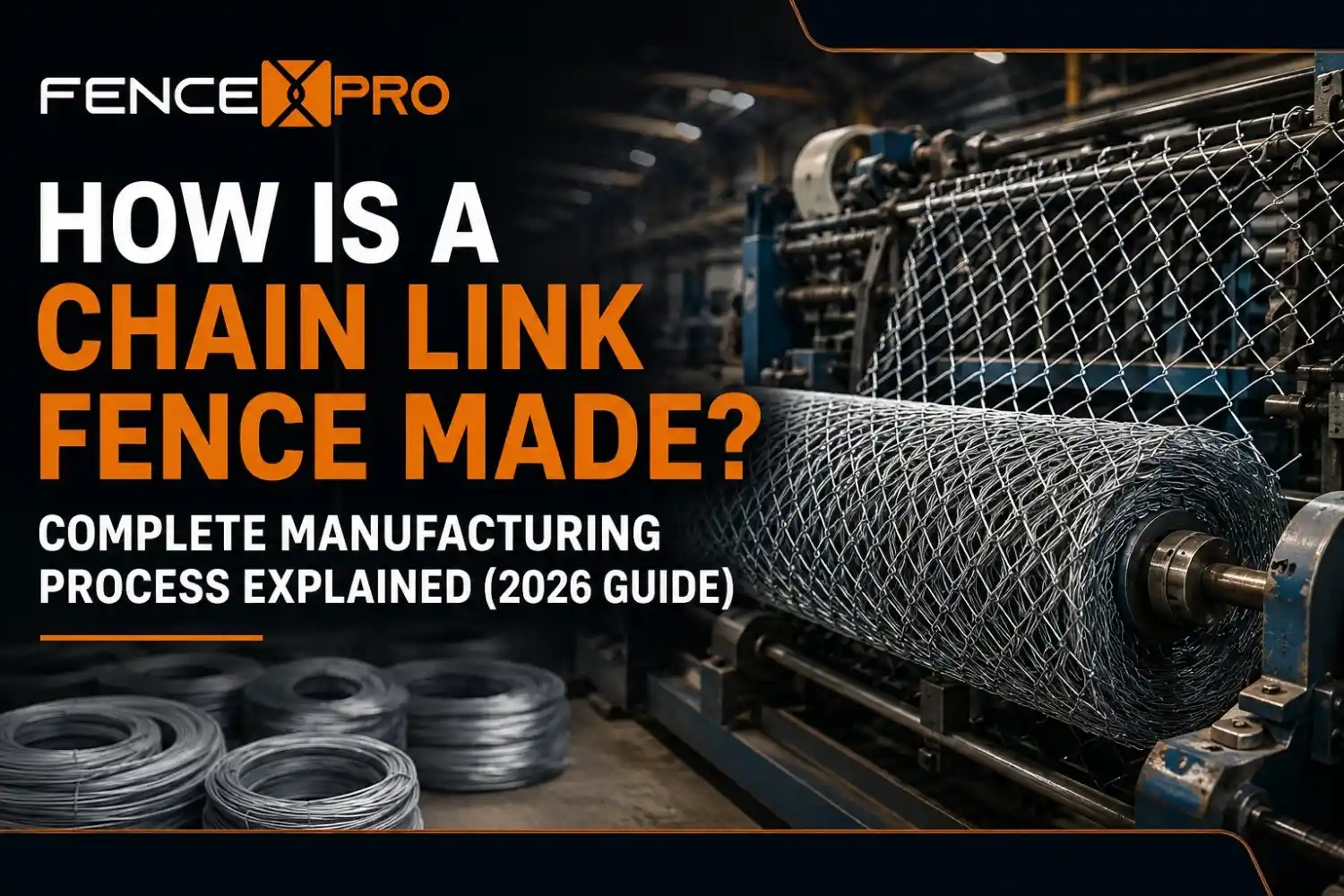
The straightened wire enters an automated chain link weaving machine, where it is bent into a continuous zigzag pattern. As each spiral rotates, it interlocks with the previous spiral, forming the familiar diamond-shaped mesh without welding.
This mechanical weaving process provides:
- Flexible fence structure
- Consistent mesh openings
- High production efficiency
- Uniform appearance
- Strong interlocking joints
Manufacturers can produce different mesh sizes and fence heights based on project requirements, making chain link fencing suitable for everything from residential boundaries to high-security industrial facilities.
Step 6: Edge Finishing
After the diamond mesh is woven, manufacturers finish the top and bottom edges of the fence to improve safety, strength, and security. The edge style depends on the intended application.
| Edge Type | Description | Best Applications |
|---|---|---|
| Knuckle Edge (K) | Wire ends are folded back to create a smooth finish. | Residential areas, schools, parks, sports grounds |
| Twist Edge (T) | Wire ends are twisted into sharp points for added security. | Industrial facilities, warehouses, commercial properties |
| Barbed Edge | Additional sharp projections provide maximum anti-climb protection. | High-security zones, military sites, prisons, restricted facilities |
Selecting the right edge finish improves both safety and the overall performance of the fencing system.
Step 7: Quality Inspection
Reputable manufacturers never ship chain link fencing without performing quality inspections. This stage ensures every roll meets the required specifications and delivers consistent performance after installation.
Quality inspection typically includes:
- Wire Diameter Test – Confirms the wire gauge matches production specifications.
- Mesh Size Inspection – Verifies that every diamond opening is uniform.
- Zinc Coating Check – Ensures proper galvanization for corrosion resistance.
- Tensile Strength Testing – Measures the wire’s ability to withstand pulling force.
- Surface Finish Inspection – Detects coating defects, scratches, or exposed steel.
- Roll Measurement – Confirms the correct height, length, and weight before dispatch.
These quality checks help prevent premature rust, uneven mesh, and structural weaknesses that can reduce the fence’s service life.
Step 8: Rolling, Packaging, and Dispatch
Once the fence passes inspection, it is compressed into compact rolls using automated rolling equipment.
This process offers several advantages:
- Reduces storage space
- Lowers transportation costs
- Protects the mesh during shipping
- Simplifies loading and unloading
- Makes installation easier on-site
For export and long-distance transportation, manufacturers often wrap each roll in waterproof woven packaging or protective film to prevent damage during transit.
Machines Used in Chain Link Fence Manufacturing
Modern factories rely on automated machinery to ensure precision, speed, and consistent product quality.
| Machine | Purpose | Benefit |
|---|---|---|
| Wire Drawing Machine | Reduces wire diameter | Uniform wire thickness |
| Hot-Dip Galvanizing Line | Applies zinc coating | Corrosion protection |
| PVC Coating Machine | Adds polymer coating | UV and weather resistance |
| Chain Link Weaving Machine | Forms diamond mesh | Accurate, high-speed production |
| Rolling Machine | Compresses finished fencing | Easier storage and transport |
| Quality Testing Equipment | Checks dimensions and strength | Consistent manufacturing quality |
Unlike many general guides, understanding the machines used in production helps buyers evaluate whether a manufacturer has the capability to deliver consistent, industrial-grade fencing.
Chain Link Fence Specifications You Should Know Before Buying
Before comparing prices, review the technical specifications that determine product quality and performance.
| Specification | Why It Matters |
|---|---|
| Wire Gauge | Determines fence strength and durability |
| Mesh Size | Affects visibility, security, and airflow |
| Fence Height | Depends on project and security requirements |
| Zinc Coating | Improves corrosion resistance and service life |
| PVC Coating Thickness | Adds weather protection and surface durability |
| Roll Length | Influences installation efficiency and material planning |
Comparing specifications instead of price alone helps you choose a fence that delivers better long-term value.
Common Mistakes Buyers Make
Avoid these common mistakes when purchasing a chain link fence:
- Choosing the lowest price without checking wire quality.
- Ignoring zinc coating thickness.
- Selecting the wrong mesh size for the application.
- Buying a thinner wire gauge than required.
- Overlooking coating quality and UV resistance.
- Not verifying manufacturing standards or quality testing.
A slightly higher-quality product often lasts significantly longer and reduces maintenance costs over time.
Factors That Affect Chain Link Fence Lifespan
Several factors influence how long a chain link fence performs effectively outdoors.
- Weather Conditions: Coastal and humid environments increase corrosion risk.
- Galvanization Quality: Heavier zinc coatings provide longer rust protection.
- Protective Coating: PVC or PE coatings improve resistance to UV exposure and moisture.
- Installation Quality: Correct tension and secure posts improve structural stability.
- Regular Maintenance: Periodic inspections and minor repairs extend service life.
- Environmental Exposure: Industrial chemicals, salt, and pollution may accelerate wear.
With proper material selection and installation, a high-quality chain link fence can provide reliable performance for many years.
Expert Tips from FenceXpro
Based on our experience supplying fencing solutions for industrial, commercial, and infrastructure projects, these practical recommendations help buyers choose better products:
- Always compare the core wire gauge, not just the overall coated thickness.
- Request zinc coating specifications before placing an order.
- Choose PVC-coated fencing for coastal or high-moisture environments.
- Inspect mesh uniformity throughout the roll before installation.
- Verify that rolls are free from damaged coating or exposed steel.
- Buy directly from a trusted manufacturer to ensure consistent quality and reliable after-sales support.
These simple checks can significantly improve long-term durability while reducing maintenance and replacement costs.
Frequently Asked Questions
How is a chain link fence made?
A chain link fence is made by drawing steel wire, applying galvanized or polymer coatings, weaving the wire into a diamond-shaped mesh, finishing the edges, performing quality inspections, and packaging the finished rolls for transportation.
What material is used to manufacture chain link fencing?
Most chain link fences are manufactured using low-carbon steel wire with galvanized or PVC-coated finishes for improved corrosion resistance.
Is galvanized chain link fencing better than PVC-coated fencing?
Galvanized fencing offers excellent corrosion protection, while PVC-coated fencing provides an additional protective layer against UV exposure, moisture, and surface wear. The best option depends on the installation environment.
Which wire gauge lasts longer?
Heavier wire gauges generally provide greater strength and durability, making them suitable for industrial, commercial, and high-security applications.
What mesh size should I choose?
Larger mesh openings are suitable for general boundary fencing, while smaller mesh sizes offer improved security and anti-climb performance.
How long does a chain link fence last?
The lifespan depends on wire quality, galvanization, protective coating, environmental conditions, installation quality, and regular maintenance.
Which coating provides the best rust protection?
Hot-dip galvanized wire offers excellent corrosion resistance, while PVC-coated galvanized wire provides additional protection in harsh outdoor environments.
What machines manufacture chain link fencing?
Manufacturers typically use wire drawing machines, galvanizing lines, PVC coating machines, chain link weaving machines, rolling machines, and quality testing equipment.
How do manufacturers test chain link fence quality?
Quality testing includes wire diameter checks, zinc coating inspection, mesh accuracy measurement, tensile strength testing, surface finish inspection, and packaging verification.
Which chain link fence is best for industrial security?
Heavy-gauge galvanized or PVC-coated chain link fencing with appropriate mesh size and security edge finishing is generally preferred for industrial facilities, warehouses, factories, and infrastructure projects.
Conclusion
Understanding how a chain link fence is made helps buyers make informed purchasing decisions based on manufacturing quality rather than price alone. Every production stage—from selecting low-carbon steel wire and applying protective galvanization to precision weaving, quality inspection, and packaging—plays a vital role in determining the fence’s strength, corrosion resistance, and lifespan.
At FenceXpro, we manufacture high-quality chain link fencing designed for industrial, commercial, infrastructure, agricultural, and residential projects. By combining premium raw materials, advanced manufacturing technology, and strict quality control, we deliver fencing solutions that offer long-lasting performance, reliable security, and excellent value.
Whether you need standard galvanized fencing or custom PVC-coated chain link mesh, choosing a trusted manufacturer ensures better quality, longer service life, and dependable protection for your property.