
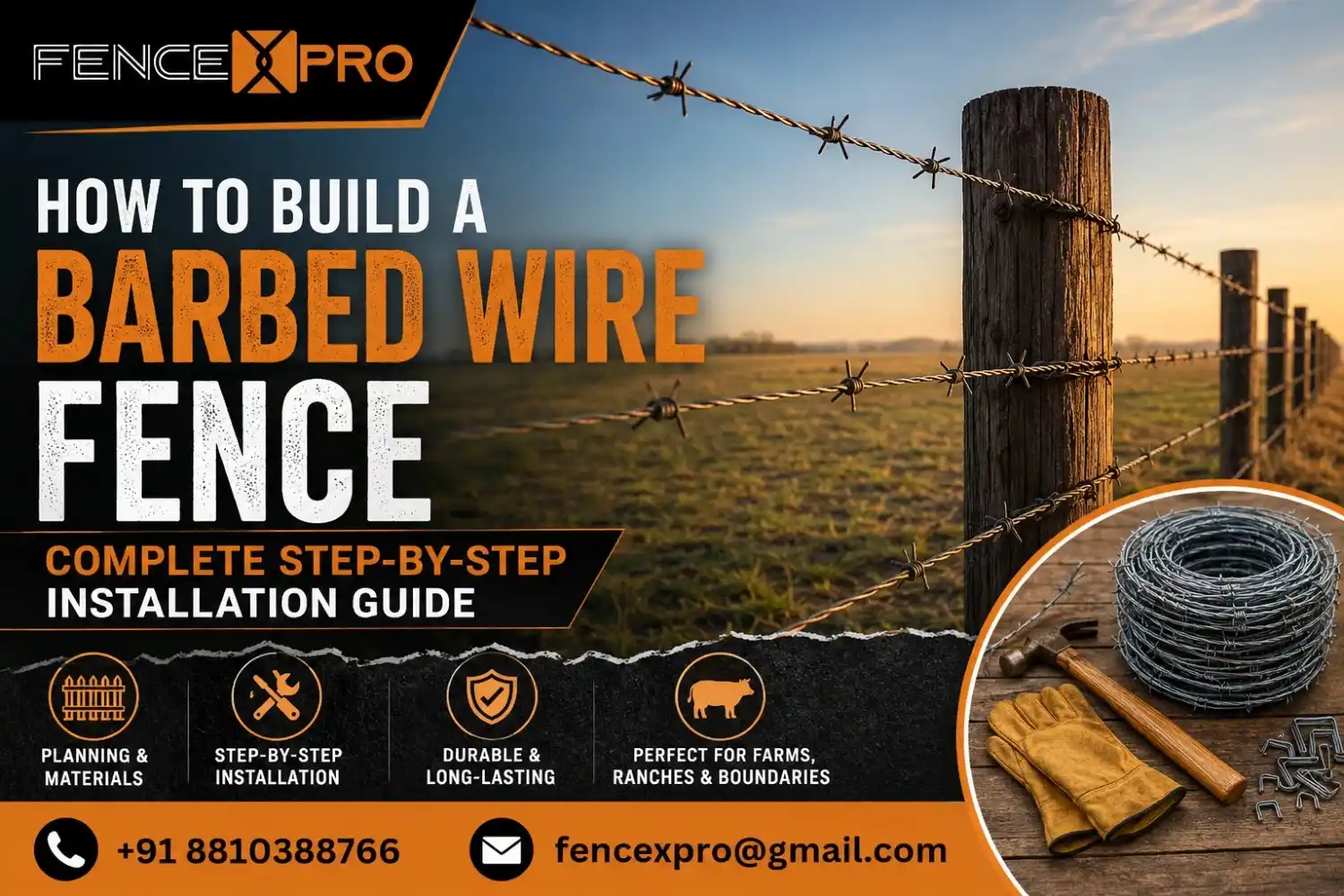
Building a barbed wire fence may seem simple, but poor planning, incorrect post spacing, and improper wire tension can lead to a weak fence that requires frequent repairs.
The good news is that with the right materials, tools, and installation techniques, you can build a strong, durable, and long-lasting barbed wire fence without unnecessary mistakes.
In this guide, you’ll learn how to build a barbed wire fence step by step, including planning, materials, post installation, wire tensioning, maintenance, common mistakes to avoid, and expert tips for achieving professional results.
Quick Facts
| Detail | Answer |
| Difficulty | Medium |
| Time Required | 1–3 Days |
| Cost | ₹35–₹120 per meter |
| Lifespan | 20–30 Years |
| Recommended Gauge | 12.5 Gauge |
| Recommended Strands | 4–5 |
| Safety Gear Needed | Gloves, eye protection |
What Is a Barbed Wire Fence?
A barbed wire fence is a boundary or containment barrier made from twisted steel wire fitted with sharp points at regular intervals. The barbs discourage animals and people from pushing through or climbing over the line, which is why the design has remained a standard choice for farms, ranches, and industrial sites for well over a century.
How a barbed wire fence works
The fence works by combining physical tension with deterrence. Strands are pulled tight between anchored posts, so the line holds its shape under pressure from livestock or weather. The barbs themselves add a layer of discomfort that keeps animals from leaning, rubbing, or forcing their way through, without needing an electrified or solid barrier.
Main components of a barbed wire fence
Every barbed wire fence relies on the same core parts working together:
- Corner and end posts – anchor points that absorb the pulling force of tensioned wire
- Line posts – intermediate supports that keep strands at consistent height
- Barbed wire strands – the horizontal barrier lines, usually galvanized steel
- Braces and H-braces – reinforce corner and end posts against wire tension
- Staples or wire clips – fasten the wire to each post
- Concrete footings – stabilize posts in loose or sandy soil
Where Is a Barbed Wire Fence Commonly Used?
Barbed wire fencing shows up anywhere a property needs a durable, low-cost barrier rather than a decorative one.
1. Farm fencing
Farms use barbed wire to mark field boundaries and separate crop areas from grazing land, giving a clear, low-maintenance dividing line across large acreages.
2. Livestock enclosures
Ranchers rely on barbed wire to keep cattle, horses, and other livestock contained within a defined pasture, since the barbs discourage animals from pressing against the line.
3. Agricultural land
Large tracts of agricultural land use barbed wire to separate ownership parcels or manage rotational grazing without the cost of solid fencing across long distances.
4. Property boundaries
Rural and semi-rural property owners use barbed wire to mark legal boundary lines clearly, which helps prevent disputes and unauthorized access.
5. Industrial premises
Industrial sites often add barbed wire along the top of perimeter fencing or as a standalone barrier to reinforce site security in lower-traffic areas.
6. Construction sites
Construction sites use temporary or semi-permanent barbed wire runs to keep the public and unauthorized vehicles away from equipment, materials, and active work zones.
Why Choose a Barbed Wire Fence?
1. Cost-effective boundary protection
Barbed wire uses far less material than solid fencing panels or mesh, which keeps the cost per linear foot low even when fencing hundreds or thousands of feet of boundary.
2. Long-lasting durability
Galvanized barbed wire resists rust and weather damage for decades, making it one of the most durable fencing options available for exposed, long-run boundaries.
3. Low maintenance
Once installed and properly tensioned, a barbed wire fence needs only occasional tightening and spot repairs rather than ongoing upkeep.
4. Effective livestock control
The barbs create a physical deterrent that keeps most livestock from testing or leaning on the fence line, reducing the chance of animals breaking through.
5. Reliable perimeter security
Multiple tensioned strands make it difficult to cut through or push past a barbed wire line quickly, adding a real barrier to unauthorized entry.
Planning Before You Build
| Define the purpose of the fence Decide whether the fence needs to contain livestock, mark a boundary, or add security, since this determines the number of strands, spacing, and post depth you’ll use. | Measure the fence line Walk and measure the full length of the planned fence line so you can calculate post counts, wire rolls, and total material needs accurately. | Assess the terrain Check for slopes, dips, rocky ground, and low spots along the route, since uneven terrain affects post placement and wire tension planning. |
| Check local regulations Confirm any local rules on fence height, boundary setbacks, or livestock fencing requirements before you dig a single hole, since regulations vary by area. | Estimate materials Use your measured fence line to calculate the number of posts, rolls of wire, and bags of concrete needed, adding a small buffer for waste and repairs | Plan gate locations Mark where gates or access points will go before setting posts, so you can install the correct bracing at those points from the start. |
Materials Required
| Material | Purpose |
| Barbed wire rolls | Main fencing strands |
| Corner and end posts | Anchor points for wire tension |
| Line posts | Intermediate wire support |
| Concrete | Stabilizes posts in the ground |
| Staples or wire clips | Fasten wire to posts |
| Brace materials | Reinforce corner and end assemblies |
Tools Required
- Post hole digger – digs holes for corner, end, and line posts
- Fence stretcher – pulls wire taut between anchor points
- Wire tensioner – fine-tunes strand tightness after stretching
- Fencing pliers – twists, cuts, and staples wire in one tool
- Wire cutters – trims wire to length
- Tape measure – checks spacing and post depth
- Spirit level – keeps posts plumb
- String line – guides a straight fence run
- Hammer – drives staples and stakes
- Safety equipment – gloves and eye protection for handling barbed wire
Barbed Wire Fence Installation Cost
| 1. Material cost Material cost depends mainly on wire gauge, coating quality, and post type, with galvanized wire and treated wooden posts sitting at the higher end of the range. | 2. Labour cost Labour cost varies with terrain difficulty and crew size, since rocky or uneven ground takes longer to dig and set posts than flat, clear land. |
| 3. Per meter cost A typical barbed wire fence costs around ₹35 to ₹120 per meter, depending on wire quality, post spacing, and whether installation is DIY or professional. | 4. Per acre cost Total cost shifts based on wire gauge, number of strands, post material, terrain difficulty, distance from suppliers, and whether labour is hired or handled as a DIY project. |
| 5. Per foot cost Converting the per-meter rate to a per-foot basis gives a rough working figure for smaller sections, gate areas, or partial repairs. | 6. Cost factors Total cost shifts based on wire gauge, number of strands, post material, terrain difficulty, distance from suppliers, and whether labour is hired or handled as a DIY project. |
Barbed Wire Gauge Comparison
| Gauge | Best Use |
| 12.5 | Farm fencing |
| 14 | Boundary fencing |
| 15.5 | Garden fencing |
| High Tensile | Security fencing |
Choosing the right gauge comes down to matching wire strength to the fence’s job: heavier 12.5-gauge wire suits the daily pressure of livestock, lighter 14 and 15.5-gauge wire works for boundary and garden lines with less load, and high-tensile wire holds up best where security and break-resistance matter most.
Recommended Fence Measurements
| Fence height Most agricultural barbed wire fences run 42 to 48 inches tall, though security fencing can extend higher. | Post spacing Line posts are typically spaced 10 to 16 feet apart, with closer spacing on uneven ground or where extra strength is needed. | Corner post depth Corner posts should be set at least 3 feet deep, since they carry the greatest load from wire tension. |
| Line post depth Line posts are generally set 2 to 2.5 feet deep, enough to hold their position without carrying heavy tension load. | Wire strand spacing Strands are commonly spaced 6 to 8 inches apart vertically, tightening toward the bottom to discourage smaller animals from slipping under. |
Step-by-Step Guide to Building a Barbed Wire Fence
Step 1: Mark the fence line
Stretch a string line between your starting and ending points to establish a straight, accurate path before digging any holes.
Step 2: Install corner posts
Dig and set corner posts first, since they anchor the tension for the entire fence run and determine the alignment of everything that follows.
Step 3: Install end and line posts
Space and set end posts and line posts along the marked line, checking each one for plumb with a spirit level as you go.
Step 4: Set posts with concrete
Pour concrete around corner, end, and any high-load posts to lock them firmly in place, then allow the concrete to cure before applying wire tension.
Step 5: Attach the first strand
Fasten the first strand of barbed wire to one corner post, leaving enough slack to pull it along the full line to the opposite anchor point.
Step 6: Stretch and tension the wire
Use a fence stretcher to pull the strand tight between anchor posts, then secure it at the far end once the tension is even along the run.
Step 7: Install the remaining strands
Repeat the attaching and stretching process for each additional strand, working from bottom to top or top to bottom at consistent spacing.
Step 8: Secure all wire connections
Staple or clip every strand to each line post so the wire holds its height and doesn’t sag between anchor points.
Step 9: Inspect the completed fence
Walk the full fence line checking tension, post stability, and strand spacing before considering the installation finished.
Common Mistakes to Avoid
- Incorrect post spacing – posts set too far apart let the fence sag and lose strength
- Weak corner posts – undersized or shallow corner posts fail under wire tension over time
- Poor wire tension – wire that’s too loose invites animals to push through, while overly tight wire increases the risk of snapping
- Uneven strand spacing – inconsistent gaps between strands create weak points that animals learn to exploit
- Shallow post installation – posts that aren’t deep enough shift or lean under load
- Skipping bracing – corners and ends without proper brace assemblies are more likely to pull out of the ground
- Ignoring terrain changes – failing to adjust post placement on slopes or dips leaves gaps under the fence line
Maintenance Tips
| Routine fence inspections Walk the fence line periodically to catch loose wire, leaning posts, or damage early, before small issues turn into full repairs. | Tighten loose wires Re-tension strands that have loosened over time using a wire tensioner, restoring the fence’s original holding strength. | Replace damaged sections Cut out and replace any section of wire that’s rusted, kinked, or broken rather than patching it temporarily. |
| Control vegetation Clear brush and tall grass along the fence line so plant growth doesn’t push against the wire or hide developing damage. | Prevent corrosion Choose galvanized wire and address any exposed or scratched coating quickly to keep rust from spreading along the strand. | Inspect posts annually Check posts each year for rot, rust, or shifting in the ground, especially at corners and ends where tension load is highest. |
Barbed Wire Fence vs Other Fencing Options
Barbed Wire vs Chain Link Fence
| Factor | Barbed Wire | Chain Link Fence |
| Cost | Lower per meter | Higher per meter |
| Security | Strong deterrent, harder to climb | Easier to climb without added toppers |
| Durability | 20–30 years (galvanized) | 15–20 years typically |
| Installation | Faster, fewer materials | More labour-intensive |
| Maintenance | Occasional re-tensioning | Panel and frame upkeep |
| Best Uses | Farms, ranches, large boundaries | Residential and commercial perimeters |
Barbed wire vs other fencing types
- Razor wire – offers a stronger deterrent than standard barbed wire and suits high-security sites, but costs more and is unsuitable for livestock areas due to the risk of serious injury
- Concertina wire – provides a denser, harder-to-breach barrier than barbed wire, typically used for military, correctional, or high-security perimeters rather than farm boundaries
- Welded mesh – gives a solid, climb-resistant barrier with a neater appearance than barbed wire, at a higher material and installation cost
- Field fence – uses woven or welded wire panels to contain smaller livestock like sheep and goats more effectively than barbed wire strands, though it costs more per meter
Why Choose FenceXPro?
High-quality galvanized barbed wire
FenceXPro supplies galvanized barbed wire built to resist corrosion and hold tension across long fence runs.
Expert fencing solutions
FenceXPro’s team supports farm, boundary, and industrial fencing projects with guidance suited to each site’s specific needs.
Reliable manufacturing standards
FenceXPro wire is manufactured to consistent gauge and coating standards, so every roll performs the same way on installation.
Bulk supply and project support
FenceXPro supports large-scale projects with bulk material supply, helping keep big fencing jobs on schedule.
Professional installation guidance
FenceXPro offers installation guidance for property owners who want expert input on planning, materials, or execution before starting the project.
Get a Barbed Wire Fencing Quote from FenceXPro
Whether you’re fencing a single field or an entire perimeter, FenceXPro offers packages to match the size and scope of your project.
| Package | What’s Included | Ideal For | Starting Price |
| Material Only | Galvanized barbed wire, posts, staples, brace materials | DIY installers who have their own tools and crew | ₹35/meter |
| Standard Installation | Materials plus professional post setting, tensioning, and finishing | Farms and boundary fencing of moderate length | ₹75/meter |
| Premium Full-Service | Materials, installation, gate fitting, and a post-installation inspection | Large properties, security fencing, and bulk projects | ₹120/meter |
Ready to fence your property the right way? Request a free quote from FenceXPro and get expert advice on materials, gauge, and installation before you start digging.
Frequently Asked Questions
Can you build a barbed wire fence on uneven ground?
Yes. Adjust post spacing and depth to follow the contour of the land, adding extra posts at dips or rises to keep the wire close to the ground along the full run.
What gauge barbed wire is best for farm fencing?
Most farm fencing uses 12.5-gauge galvanized barbed wire, which balances strength with ease of handling and tensioning.
How tight should barbed wire be?
Wire should be taut enough to resist sagging and pressure from livestock, but not so tight that it risks snapping under temperature changes or impact.
Can existing fence posts be reused?
Existing posts can be reused if they’re still structurally sound, free of rot or rust damage, and set at a depth that matches your new fence’s tension requirements.
How long does a galvanized barbed wire fence last?
A well-installed galvanized barbed wire fence typically lasts 20 to 30 years with routine maintenance.
How often should a fence be inspected?
Inspect the fence at least twice a year, with additional checks after severe weather or heavy livestock activity.
Is concrete necessary for every fence post?
Concrete is generally needed only for corner, end, and gate posts, since these carry the most tension; line posts can often be set with tamped soil.
What is the best season to install a barbed wire fence?
Late spring through early fall is ideal, since the ground is workable for digging and concrete cures reliably in moderate temperatures.
Can barbed wire be installed on metal and wooden posts?
Yes. Barbed wire works with both metal T-posts and wooden posts, though the attachment method differs between wire clips for metal and staples for wood.
How can you extend the lifespan of a barbed wire fence?
Regular tension checks, prompt repair of damaged sections, and vegetation control along the fence line all help extend the fence’s usable life.